Back in the spring of this year, when I was putting the pieces in place for this season's programme I thought I'd mix things up a bit by not giving an end-of-season pre-concert talk. Sir Mark Elder was conducting the final concert and he always gets a huge crowd when he does the pre-concert talks, so it was obviously the right thing to give way to him. Watching BBC 4's Symphony programme recently has also been a telling reminder of what a superb advocate he is for orchestral music.
The sensible thing to have done at that point would have been to book in the pre-concert talks as normal and take a break from this season. But somewhere my adventurous (for which read reckless) head took hold and I decided I've have a go at a beginner's guide to a concert. Since I'd had the most input into the Halle's concert on 24 November, that seemed the obvious slot to pick...et voila!
Of course, it's obvious enough until you sit down to write the thing! Yes, I knew all the pieces pretty well, and they all had great stories attached to them. As a group of composers, Dukas, Jongen , Faure and Respighi also fit together really well, so there wouldn't be a problem finding enough to say about them. But when you've got just half an hour to cover the essential points with some musical illustrations and a bit of anecdote, it really hits you how much of this game is about leaving stuff out. And pitching it correctly - not being too technical, or basic, formal or informal, was a real headache.
I read my first draft out to Deb, my wife, as we drove down to London on Saturday. Speaking at a speed that would be far too quick for a lively acoustic like the Royal Concert Hall, I managed it in 29 minutes. But that left out six music clips and a five minute chat with the organist, Jonathan Scott. Yesterday afternoon saw the text reduced by a page, making it just about workable. But I'll still need another evening spent on it tonight, to get it to a comfortable length. And I've got a handout to make, too. All in all I suspect Ill have spent about a week, on and off, on a talk that will be over in thirty minutes. Hopefully it'll all be worth it but I reckon that next time I'll stick to a conversation piece.
If you're curious, my first ever pre-concert talk (in the proper sense) will be at 6.30pm on Thursday 24 November in the auditorium.
Monday, 21 November 2011

Sunday, 30 October 2011
What a difference a year makes
This morning was one of those rare occasions when I was grateful for the clocks going back. Normally this signals the start of at least a week's lugubriously mood as I come to terms with the prospect of four months of long nights. However, as I had to get up at 6.45pm on a Sunday to go down to the Royal Concert Hall to let in the piano technician in advance of the first Sunday Morning Piano Series of 2011-2012, I was relieved to get an extra hour in bed.
And it turned out to be one of those days where I felt really pleased by the outcome. We launched the Piano Series as a pilot, hoping we'd get big enough audiences for the series to break even, but by the end of last season it was clear that we'd done substantially better and would be able to continue the series if we could maintain the box office performance.
So this season I've been scanning the sales figures and hoping that the marketing has done its job and that the momentum from last season has carried through into this one. You can never tell with something like the Sunday Piano Series because quite a large percentage of the sales are taken on the door, rather than through advance sales. Now this morning, as I was 'walking the floors' it felt really busy and it looked like the walk up had been big. When I checked the sales report afterwards I discovered that we'd sold 120 tickets on the door alone, with a total audience of 438.
This is a really significant figure. Not only is it our largest paying audience so far in the series - getting on for nearly 50 more than in the previous season, but an audience that size means that the concerts, far from costing us anything, actually contribute positively to the overall Nottingham Classics income. And at a time when Nottingham Classics no longer receives any direct subsidy, finding alternative income streams is hugely important.
So, that's a really good piece of news at the start of this season. And the signs from the orchestral series are also very encouraging. This time last year I was actually feeling quite deflated by the slow start we'd made, and it took until January for things to turn around. From discussions I've had with other arts marketers it seems this wasn't confined to us. This season, however, we've had two really good houses and we are firmly in the black...
...so far. I'm not going to tempt fate by making any predictions but the next two concerts - 9 and 24 November - are performing well, even though in some respects they represent something of a risk. For Nottingham Classics, being able to take some risks with repertoire is vital if we're going to keep the season fresh and to offer the opportunity for discovery, particularly amongst the regular subscribers upon whose loyalty the season depends. For a venue like the Royal Concert Hall, without its own professional symphony orchestra, a piece like Shostakovich's Leningrad Symphony on 9 November is a difficult one to call. Yes, it has a great story behind it and, yes, it is an epic piece that will sound fantastic in the RCH's famous acoustic, but that's no guarantee of success. Similarly, the Halle concert on 24 November is something of a wildcard because although three of the pieces are familiar, the central piece - Joseph Jongen's Symphonie Concertante for Organ and Orchestra - is almost unknown and lack of familiarity can prove an insurmountable obstacle when trying to persuade a potential audience to buy tickets.
As it's turning out, though, it looks like many of the Nottingham Classics audience are going to give Jongen's piece a go, which I'm delighted by because it's a truly amazing piece. It was a highly unusual commission, written especially for the Wanamaker Organ in the Philadelphia Department Store of the same name. These days it's barely conceivable to think that anyone would want to build the largest pipe organ in the world in a department store, but that's exactly what the Wanamaker family did. And it's still the biggest in the world, and a mighty impressive instrument, too. My wife, Deb, has just been to a conference in Philadelphia and she made special trip to Macy's (as it now is) to hear the organ being played. And here's the proof:
http://www.youtube.com/watch?v=8MixP8cCi9Q&feature=youtube_gdata_player
We don't, of course, have a pipe organ like that in the RCH; indeed, there aren't any pipes at all, but I'm confident that Jonathan Scott can work similar magic on our electronic organ as he did with the Saint-Saens in June last year. It's one of his favourite pieces but he doesn't get that many chances to perform it because, almost inexplicably to me, Jongen's piece rarely gets programmed. But if you've never heard it then you're in for a treat. It's one of those pieces I listen to very often because its blend of rich Romanticism, exotic impressionism and sheer, virtuosic brilliance never fails to generate a tingle.
Anyway, if we do as well at the box office as I think we might, then we will have enjoyed a significantly stronger start in 2011-2012 and, knowing how valuable good news is in times like these, that's something worth getting up for at 6.45/7.45am on a dreary Sunday morning.
Bye for now,
Neil
Thursday, 15 September 2011
A tale of three Proms...and one amazing house
A new season approaches so it's time to dust off the blog and let you in on a few things that have been happening in the world of Nottingham Classics.
Last week I took the chance to get down to London to hear some of the BBC Proms. The thought of making several separate trips down and enduring the late train back (and by 2.00am it does start to feel like the slowest train in history) was enough to prompt me to do three in a row and stay in London for a couple of days. It's not as expensive as you might think. Over the last couple of years my wife Deb and I have discovered the joys of LSE accomodation. It has a half dozen colleges dotted around central London and they're often staggering value - my last two nights, about three minutes walk from Sadlers Wells - cost me £32 each, including very big breakfast, part of which got recycled into lunch. It's not the Ritz, but it's not bad either - maybe one to consider next time you're doing a cultural overnighter in the big city.
And the fringe benefit of staying a couple of nights was having the time to experience a few of London's special places. Before I went, you may remember me asking for a few suggestions from the Nottingham Classics audience - which proved to be really rewarding. Of the places suggested I made it to two characterful pubs - the George Inn in Southwark (a 17th century courtyard inn owned by the National Trust - thanks to Anna Lloyd for the recommendation) and the Princess Louise in Holborn (an opulent Victorian drinkery) - a sophisticated Italian 'tapas' restaurant, Polpo, in Soho (thanks to Peter Speakman for both of these), and a really astonishing museum. I'd never been to the Sir John Soames Museum, in Lincoln Fields, just off Holborn, but the fact that four of you suggested it meant that it went to the top of the list. And what an amazing place it is! - a monument to a great architect's passion for antiquities with every room crammed with great paintings, exquisite architectural models and huge chunks of Greek and Roman temples, sometimes suspended in improbable places. Here's a snapshot to give you a flavour.

Poor Sir John ended his days a rather bitter man, alienated from his sons and something of a recluse but he certainly left a wonderful legacy behind. The picture room, containing treasures such as paintings by Canaletto and Hogarth is a real eye-opener, not least because the room itself has massive panels which actually function as extra walls for hanging even more great paintings. It was one of the highlights of the last couple of years for me so thanks to Peter Speakman, Kath Jones, Pauline Hillyard and Dorothy Kurpanik for the recommendation.
As for the Proms themselves, I really couldn't have done much better. I did the Pittsburgh Symphony on 6th September, BBC Symphony on 7th and Philadelphia on 8th, with a late nighter by the BBC big band on 7th. They all had something special to enjoy, whether in Anne-Sophie Mutter's stratospheric lines in Wolfgang Rihm's Gesungene Zeit or the Pittsburgh Symphony's flawless horn section in Mahler's 5th. Even Sir Harrison Birtwistle seems to have taken on the status of 'grand old man of music' these days, judging by the ovation after his angular Violin Concerto. Charles Dutoit's peerless stick technique really impressed me in the Rachmaninov Symphonic Dances and there was real sheen to the legendary Philadelphia strings. Perhaps the only disappointment was David Robertson's rather earthbound The Planets but that was followed by the BBC Big Band's tribute to Stan Kenton, whose often-derided progressive jazz was fiercely exciting, harmonically rich and played for all it was worth by a crack ensemble. Claire Martin's effortless vocals added some real class to a really enjoyable event. Band leader Jiggs Whigham certainly approved of the red dress!
After four concerts and two days of almost non-stop walking around the city I was ready for a return to the office chair, but, as ever, it was a great privilege to hear some of the world's great orchestras in some heavyweight repertoire. Inspiring, too - it certainly got me in the mood for thinking about the shape of next season.
Which is a big one, of course. 2012-2013 is the 10th anniversary of the Halle's residency in Nottingham, a very important moment in the history of Nottingham Classics and the point at which things really began to look up for the series. The times we're in and the squeeze on our finances will mean we'll have to be imaginative but we'll definitely be celebrating the anniversary throughout the season. I've got almost half of the concerts booked in now and it's looking really exciting so far, but there's still a long way to go. And not forgetting that we start the 2011-2012 season in a fortnight with the Halle and the wonderful German cellist, Alban Gerhardt. Alban is not only a very exciting performer but he's also a really engaging commentator on music and on the ups and downs of being a soloist. His blog is always worth reading - you can sign up at http://www.albangerhardt.com/ and you can hear his thoughts on Dvorak's Cello Concerto which he thinks may be the best concerto ever written in a video on YouTube - http://www.youtube.com/watch?v=kkjEbF0ulOw - highly recommended, not just for his insights into the piece, but also for some demonstrations of his prowess as a performer.
That's it for now. More to follow in a fortnight.
Neil
Last week I took the chance to get down to London to hear some of the BBC Proms. The thought of making several separate trips down and enduring the late train back (and by 2.00am it does start to feel like the slowest train in history) was enough to prompt me to do three in a row and stay in London for a couple of days. It's not as expensive as you might think. Over the last couple of years my wife Deb and I have discovered the joys of LSE accomodation. It has a half dozen colleges dotted around central London and they're often staggering value - my last two nights, about three minutes walk from Sadlers Wells - cost me £32 each, including very big breakfast, part of which got recycled into lunch. It's not the Ritz, but it's not bad either - maybe one to consider next time you're doing a cultural overnighter in the big city.
And the fringe benefit of staying a couple of nights was having the time to experience a few of London's special places. Before I went, you may remember me asking for a few suggestions from the Nottingham Classics audience - which proved to be really rewarding. Of the places suggested I made it to two characterful pubs - the George Inn in Southwark (a 17th century courtyard inn owned by the National Trust - thanks to Anna Lloyd for the recommendation) and the Princess Louise in Holborn (an opulent Victorian drinkery) - a sophisticated Italian 'tapas' restaurant, Polpo, in Soho (thanks to Peter Speakman for both of these), and a really astonishing museum. I'd never been to the Sir John Soames Museum, in Lincoln Fields, just off Holborn, but the fact that four of you suggested it meant that it went to the top of the list. And what an amazing place it is! - a monument to a great architect's passion for antiquities with every room crammed with great paintings, exquisite architectural models and huge chunks of Greek and Roman temples, sometimes suspended in improbable places. Here's a snapshot to give you a flavour.

Poor Sir John ended his days a rather bitter man, alienated from his sons and something of a recluse but he certainly left a wonderful legacy behind. The picture room, containing treasures such as paintings by Canaletto and Hogarth is a real eye-opener, not least because the room itself has massive panels which actually function as extra walls for hanging even more great paintings. It was one of the highlights of the last couple of years for me so thanks to Peter Speakman, Kath Jones, Pauline Hillyard and Dorothy Kurpanik for the recommendation.
As for the Proms themselves, I really couldn't have done much better. I did the Pittsburgh Symphony on 6th September, BBC Symphony on 7th and Philadelphia on 8th, with a late nighter by the BBC big band on 7th. They all had something special to enjoy, whether in Anne-Sophie Mutter's stratospheric lines in Wolfgang Rihm's Gesungene Zeit or the Pittsburgh Symphony's flawless horn section in Mahler's 5th. Even Sir Harrison Birtwistle seems to have taken on the status of 'grand old man of music' these days, judging by the ovation after his angular Violin Concerto. Charles Dutoit's peerless stick technique really impressed me in the Rachmaninov Symphonic Dances and there was real sheen to the legendary Philadelphia strings. Perhaps the only disappointment was David Robertson's rather earthbound The Planets but that was followed by the BBC Big Band's tribute to Stan Kenton, whose often-derided progressive jazz was fiercely exciting, harmonically rich and played for all it was worth by a crack ensemble. Claire Martin's effortless vocals added some real class to a really enjoyable event. Band leader Jiggs Whigham certainly approved of the red dress!
After four concerts and two days of almost non-stop walking around the city I was ready for a return to the office chair, but, as ever, it was a great privilege to hear some of the world's great orchestras in some heavyweight repertoire. Inspiring, too - it certainly got me in the mood for thinking about the shape of next season.
Which is a big one, of course. 2012-2013 is the 10th anniversary of the Halle's residency in Nottingham, a very important moment in the history of Nottingham Classics and the point at which things really began to look up for the series. The times we're in and the squeeze on our finances will mean we'll have to be imaginative but we'll definitely be celebrating the anniversary throughout the season. I've got almost half of the concerts booked in now and it's looking really exciting so far, but there's still a long way to go. And not forgetting that we start the 2011-2012 season in a fortnight with the Halle and the wonderful German cellist, Alban Gerhardt. Alban is not only a very exciting performer but he's also a really engaging commentator on music and on the ups and downs of being a soloist. His blog is always worth reading - you can sign up at http://www.albangerhardt.com/ and you can hear his thoughts on Dvorak's Cello Concerto which he thinks may be the best concerto ever written in a video on YouTube - http://www.youtube.com/watch?v=kkjEbF0ulOw - highly recommended, not just for his insights into the piece, but also for some demonstrations of his prowess as a performer.
That's it for now. More to follow in a fortnight.
Neil
Monday, 10 January 2011
Monday mayhem - it must be the end of the holiday
This year I and my wife Deb took the unusual step of taking a week off immediately after new year. We didn't go anywhere (unless you count a day away at Clumber Park Hotel Spa as a short term break) and chose to spend a few days at home recharging the batteries before plunging into our respectively busiest periods of 2011. As usual we somehow found a way to add some toil to the break and spent a few days on the next D-I-Y project (an endeavour always tinged with tension for us) but overall it was a pretty relaxing time. Just enough, in fact, to go back to work with a renewed sense of purpose.
And it's just as well, as the first day back has proven to be as frenetic as anything I can remember. That maybe something to do with having (in a moment of unguarded enthusiasm last season) piling up new projects in the early Spring, including some that are going to take up a helluva lot of time. The main one that's pre-occupying me as I type is the BBC Philharmonic's family concert on 3 April - not just because we've not run a large scale family event before as part of Nottingham Classics during the time I've been working on the series, but also because we've added some whistles and bells in the form of the Nottinghamshire and Nottingham City Family Orchestra. The model is a proven one - the BBC Philharmonic created the Salford Family Orchestra a year and a bit ago as a means of engaging more deeply with its local community and of providing an inspiring opportunity for its participants to perform in a big public concert (The BBC Proms in fact). And the response was really wholehearted from those who took part. We're hoping to do the same in Nottinghamshire and most things are now in place - our first applications for places came in at the end of last week. But even after several hours organising it there's still seemingly a mountain of things to do. I had intended, arriving back in the office to make some real headway today but I should have known better. With next season still taking shape, our first concerts this weekend and the end of next week, and numerous bits of admin to sort out, the window of opportunity quickly turned into a porthole and many things are now on the to-do list for tomorrow.
Oh well, at least I did stick to one of my New Year's resolutions and used my lunch hour to pick up my shiny new bass trombone and get to work on remembering how to play it. I'm going to be joining the University Philharmonia in a performance of Berlioz's Symphonie Fantastique in February and I really need to put in some hard yards to get some semblance of tone and technique back. I guess it's a bit like rejoining a gym after several months spent avoiding it - your know what you're meant to be able to do but your body just won't play ball. Nevertheless I figured that 30 minutes to an hour of hard graft through scales, legato exercises, and lip flexibilities would be manageable even within the non-stop environment of the Royal Concert Hall.
Well...just! By the time I'd worked my way through the emails, meetings, phone calls and proofing it was 4 o'clock - a late lunch by anyone's standards. Nevertheless I did manage 20 minutes' practice and used the time to try out the sample orchestral chair which we're considering to replace the long-serving and, frankly, exhausted chairs that have been here since 1982. And, I'm pleased to say, it was really excellent - plenty of support, the right shape and a serious looking chair to boot. Let's hope the orchestras like them too.
So, the first day back was as relentless as expected, probably more so, but inch by inch the pieces are falling into place. The next big thing is turning the draft 2011-2012 programme into a fully-fledged season. And there are four Sunday morning piano series concerts to add in too - apart from one date in the diary I haven't done anything with these yet. I have a feeling that there will be a few more late lunches this Spring.
Thursday, 4 November 2010
Cometh the hour, cometh Cordelia...and Natalie
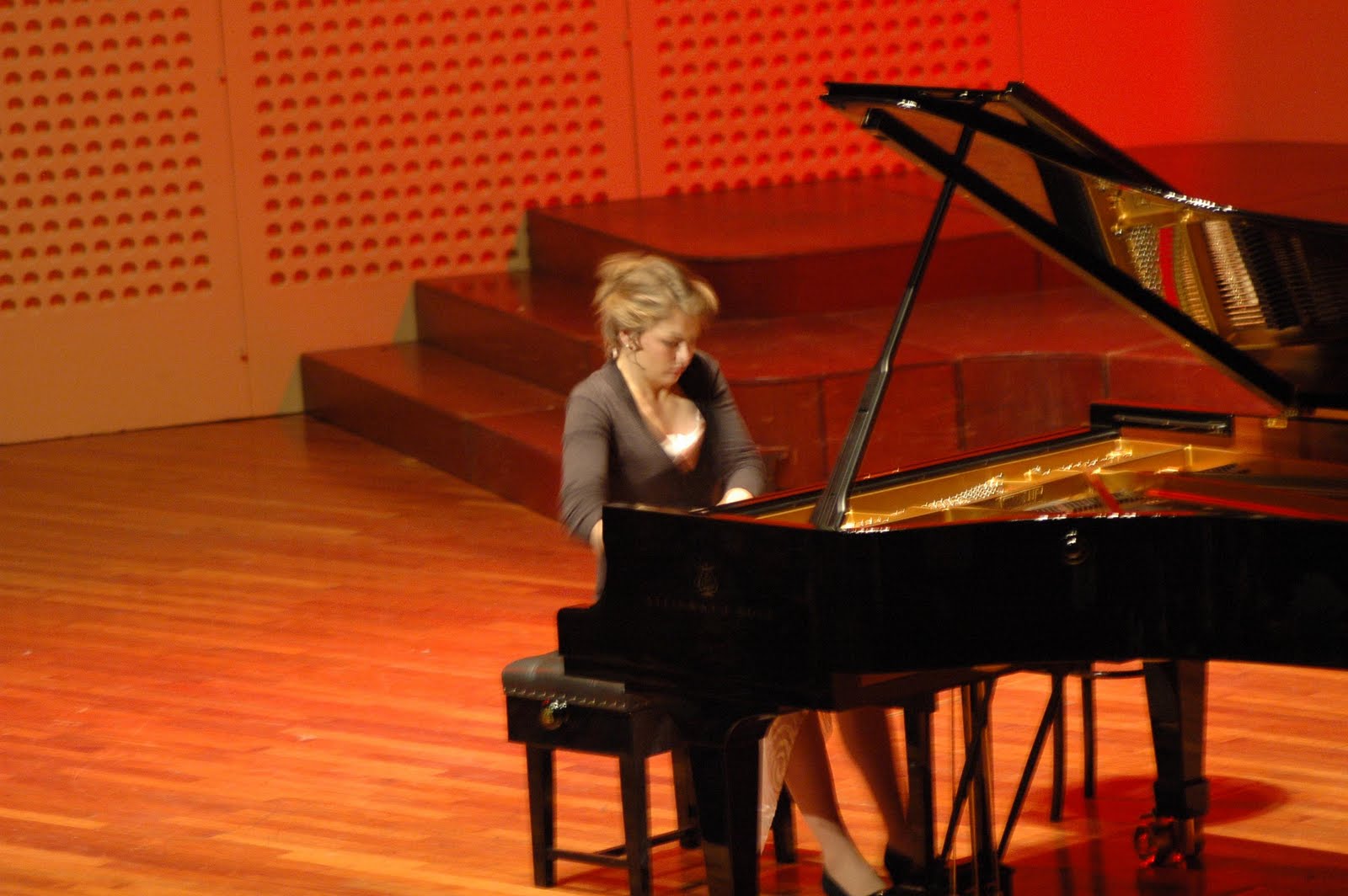
Cordelia Williams launching our new Sunday Morning Piano Series on 31 October
Another day at the office closes so whilst I wait to go and see Habit of Art next door I thought I'd use the time productively and post another entry. One thing that strikes me about this season - by adding what seems like just a few concerts it's made things feel a whole lot busier. On Sunday we were watching Cordelia Williams launch our Sunday Morning Piano Series and then, two days later, Natalie Clein was giving her first performance of Barber's cello concerto with sinfonia ViVA. And next Monday Lars Vogt is with us for our first evening recital.
Not that I'm complaining. I'm sure that if you were there to hear Cordelia's performance you'll have felt as privileged as I was to hear pianism of that quality and enjoy her assured and engaging introductions to the pieces. I have to thank Kevin Appleby from Turner Sims concert hall for this because, whilst I was looking for some rising stars to perform in the Sunday Series, he gave me the tip-off that Cordelia was a brilliant talent and also a persuasive advocate for the piano. And right from the start she was really great to work with and brought bags of positive energy to the project. She's now working on a project called Cafe Muse in London, where she's taking the classical piano into cafes and bars in search of new audiences. To find out more visit http://www.cordeliawilliams.net/. I'm sure that London's cafe culture is in for a treat. I'm still savouring the memory of Gaspard de la Nuit, a big favourite of mine and one of those pieces that seems to require an extra brain to perform (the photo above is my rather poor effort to capture it on camera). The same could be said of Jenny Lin's late nighter on 7 October - another astonishing performance.
Last night's performance by sinfonia ViVA gave us more evidence of how less can be more. A smaller orchestra than our usual bands performed to a smaller audience (still over 1000, but I always find it difficult to take comfort in that) but for me it was one of the most rewarding concerts I've heard at the Royal Concert Hall. For one thing, the programme - a rich mix of diverse twentieth century masterpieces - really played to ViVA's strengths. The impact of Andre de Ridder in inspiring the kind of incisive and committed performance we heard last night has been deep and far-reaching. The dialogue with Natalie in Barber's concerto was as gripping as an episiode of Mad Men with inspiration flowing in both directions. And it was fantastic to see so many people stay on for the After:Hours performance. Those who did will certainly have had their money's worth from Natalie, whose Bach Cello Suite No.2 was wonderfully articulated throughout. It's great to see an artist so immersed in a performance and able to connect so stringly with the audience. Speaking to her afterwards she remarked once again on how warm the audience is here. And she's right, of course.
One last thing - I'm delighted to be getting a few comments now on how good the Steinway is sounding now. It's taken a little while to settle down but, following a day of fine-tuning from Ulrich Gerhartz, Steinway's Director of Concert and Artists Services (a really nice chap by the way) it is now in fine form. Which is just as well because Lars Vogt will be working his magic on it this Monday.
I've got 20 spare minutes now - better get the next press release written! Bye for now.
Neil
Tuesday, 12 October 2010
Let them eat cake - and enjoy a piano recital

Last Wednesday was one of those days in the office where the staff come together in an impressive show of unity, taking valuable time away from their busy schedules to work towards the common good of the venue.
Having said that, the task in hand wasn't one of the more arduous ones. On this occasion we all came together in the Level 2 foyer to eat cake. That's Lucy, our Press Officer, leading the way on the left.
And the reason for this unusual treat? Simply that on 31 October we're hosting our first Sunday Morning Piano Concert and one of the vital parts of the package is the cake that gets served with the tea and coffee after the event. Some sampling was therefore essential.
And what were we looking for? Firstly, the cake needed to have a home-made feel. Concert-goers would rightly feel a bit let down if they were served with something that came cellophane-wrapped (even if they were exceedingly good). Our feeling was that something homemade, not unlike the tempting treats on offer when the WI have their annual conference here, would be right for the occasion.
The cake also needed to be practical. Given that we might be serving 500 people or more, and that there wouldn't be room for everyone to sit down with a separate plate and fork, it needed to have a certain amount of internal strength to be picked up with fingers and to rest, when halved, on a saucer next to the cup.
Very gooey cakes were, reluctantly, ruled out. But moist, flavoursome, loaf-style cakes were definitely in and I have to say that Stuart, our new catering manager, really delivered for us. Believe it or not, he managed to find a solicitor who, as a side line, ran a business making home made cakes. And very good they were, too - we've chosen three types for the opening concert on 31 October and we hope that, if you're going to hear Cordelia Williams on 31 October, then you'll enjoy them as much as we did.
And on that subject, within the next month we'll have heard our first two solo piano concerts, with none other than Lars Vogt performing on Monday 8 November. Launching a new series like this is always a nerve-wracking business. Will our hunch that there's an audience for a programme like this be correct? Will the pianist like the venue...and the piano? Lots to ponder and we'll know more by the end of this year. But at least we know that when you have your cake on 31 October you'll definitely want to eat it.
Bye for now,
Neil
Sunday, 19 September 2010
Just how many do you need for a Symphony of a thousand?

Strangely unsettling picture of the month
Sorry - couldn't resist this. We went to Carcassonne in the south west of France for our hols this summer and, by chance, arrived in the middle of one of the city's many festivals. In addition to many visiting bands there were plenty of local folk groups, many of which included bagpipes. But when I say bagpipes, we're not talking about the tartan-trimmed version used in Scotland, nor the discreet Northumbrian incarnation; no, we're talking about something that leaves little to the imagination regarding the raw materials. When it gets played it looks distinctly odd. It might get you arrested in some countries!
I went to Birmingham this weekend. My wife Deb and I took the opportunity to drop into the Electric Cinema (the UK's oldest, where you can sit on a sofa at the back and have tea and cake whilst you watch) to hear Baba Brinkman's Rap Guide to Evolution (not as mad as it sounds) and to haul ourselves round the Bull Ring in search of autumn clothes.
But the real reason we were there was to hear Mahler's 8th Symphony performed by the City of Birmingham Symphony Orchestra under their Music Director Andris Nelsons. Those of you who have seen Andris conduct will not be surprised to hear that it was stunning and that the evening had several moments of music that were so overwhelming you had to remember to breathe afterwards.
Whilst we were waiting for the performance to begin I did a quick head count of the performers. The famous 'Symphony of a Thousand' was really about half that number, but that's still a heck of a lot of orchestral players, soloists and choir members and, I had to admit sadly, too many probably for our own hall to accomodate. I wondered about this because in two years time we'll actually be celebrating the 10th anniversary of the Hallé's residency in Nottingham and I'll be beginning discussions with them next week about what should be in the programme. Obviously you'd want Sir Mark Elder (as much as possible) and Markus Stenz, but what pieces of music would do justice not only to the Hallé's achievements here, but also to the close ties between the orchestra, the Royal Concert Hall and the audiences that have taken the Hallé to their hearts.
It looks like Mahler 8 would be out on purely logistic grounds. But what about pieces that show off the Hallé's particular strengths - Elgar, Strauss etc. - or those with whom Sir Mark is closely associated, such as Verdi and Wagner. We might not be able to do Mahler 8 but maybe the Verdi Requiem? If there's going to be a gala event (which I'm sure there will) then what's an appropriately celebratory piece?
So, plenty to mull over during the coming months. In the meantime I'm taking a bigger than usual interest in the ticket sales for the coming season, mainly because I took a bit of a bold step and increased the size of the orchestral season, whilst also adding a piano series. It's possible that the timing could have been better (one look at the newspaper front pages any day of the week will tell you that!) and I'm bracing myself for a long slog up to 27 May next year. Word from other venues is that booking is later this year. Now we have to wait and see if they're just slower...or lower!
Fingers crossed, the positive feedback I've had about next season will translate into big audiences, but you never know in this game. The first time I worked on Nottingham Classics back in 2005 the mighty London Symphony Orchestra had one of the lowest audiences that season whilst in 2009 the Hallé played Nielsen's 5th Symphony to over 2000 people - a concert for which Peter Bolton and I predicted an audience just over half that size. Let's hope that that spirit of adventure continues next year. It'll certainly reduce my stress levels if it does.
Do feel free to send me your suggestions for Hallé 10th anniversary concerts. I can't promise that you'll find them taking pride of place in 2012-2013 but I'd certainly be intersted to hear them.
That's all folks!
Neil
Friday, 11 June 2010
Looking back, looking forward

For that very simple reason, this blog is going to be a short one. But I couldn't let the final concert go without a couple of comments. It's great to finish on such a high note and I trust those who heard it will have enjoyed the Saint-Saens Organ Symphony as much as I did. Though in my case the feeling was mixed with one of relief that our electronic organ had really delivered the kind of awe-inspiring experience that you'd expect of a Romantic titan like the Saint-Saens. The finale was every bit as exciting as I could have hoped but actually it was the calm of the second movement that held the most fascination for me. The deep-breathing sounds of the organ pedals had a wonderfully physical impact and I enjoyed watching several members of the audience in the front left of Tier 1 leaning over to see what Jonathan was doing. As the Widor encore really revealed, he's a fabulous organist and I don't think I've ever heard such a range of expression (including a magical whispered quiet section) in this spectacular favourite. It's really got me thinking about what opportunities there would be to get Jonathan back here soon.
As I say, it was a really great way to end the season and it was also good to see how many people styed to hear the Halle's tango Frambuesas after the concert. All in all it felt like we'd ended the season in just the right way. The feedback I've had is that 2009-2010 has been really successful and it's been hugely encouraging to get the kind of positive comments that we've had throughout the season.
But what were your highlights? I'd really love to know. There are several for me and it's difficult for me to choose. Mahler 2 is an obvious candidate, but what about Nielsen 4 or Rodrigo's Concierto de Aranjuez? Very different pieces, evoking different responses, but all wonderfully played. If you've got a particular memory, why not let me know by posting a response? - it's always fascinating to hear your thoughts on this.
Looking ahead I'd also love to know what you make of 2010-2011. The last season's going to be a difficult act to follow, and getting the blend between the popular and more adventurous elements in the programme continues to be the biggest challenge we face. Have we got it right? And how do you view the new piano series - the biggest development in the programme for several years and, dare I say it, a bit of a calculated risk on our part?
I'm sure that gives you plenty to think about. If you've got a couple of minutes, fire me a quick reply. You can be as brief, expansive and as candid as you like.
Looking forward to hearing your views.
See you in the autumn!
Neil
Saturday, 1 May 2010
Nottingham's spirit of adventure
I’ve just recently returned from hearing the London Symphony Orchestra at the Barbican in London. I hadn't seen them in quite a while but the programme in this instance really appealed to me – enough to drag me out of my brochure-numbed state and get myself organized to trek down to London.
I’m very glad I did. After the easygoing opener (Liadov’s The Enchanted Lake – a bit of a take it or leave it piece for me if I’m honest) we got a gripping performance of Rachmaninov’s 4th Piano Concerto from Lief Ove Andsnes. And it got a great reception, too – which is interesting because it’s the concerto that seems not to get programmed as often as the composer’s other three. It certainly got my mind whirring about when we might get it into a future season. So that’s at least tipped you off that, whatever is in next season, Rach 4 isn’t.
Anyway, I digress. The other work in the LSO programme – the main reason I went – was Copland’s 3rd Symphony. In many ways it’s an amalgam of his various styles – the serenity of Appalachian Spring, the energy (and almost the sense of the wild frontier) of his ballets, Rodeo and Billy the Kid, and the gentle dissonance of his more avant garde pieces. If that sounds like a piece that can’t make up its mind then I should say that I found it utterly convincing – and also hugely exciting. I’m a bit biased because, as a brass player, there’s nothing quite like hearing the LSO brass section in full cry (this is the orchestra that put the fire into Luke Skywalker’s light sabre). And it must be said Copland 3 is a real roasting for the brass. Even the esteemed LSO principals couldn’t get through it entirely unscathed. But no occasional split note can detract from the thrilling experience overall.
So what’s this got to do with Nottingham Classics, you might be asking. Well, a couple of things, really. One is that it made me wonder whether this might be a viable item for a future concert at the RCH. The other is that I found it fascinating that where I was sitting there were quite a few empty seats in the second half. The chap sitting next to me told me that he couldn’t follow the Rachmaninov with something else because it would impair the pleasure he’d got from it. I thought this was pretty extraordinary – does hearing a really powerful final work really have that kind of impact on what’s gone before? It would never occur to me, but I do know that it’s not that untypical. I went to hear Strauss’s Ein Heldenleben in Leicester a couple of seasons ago and, again, was surprised to see how many people weren’t there to hear it, having only gone for the Brahms 2nd Piano Concerto that preceded it.
But what this is all leading up to is an observation about audiences in Nottingham. In the 2008-2009 season it would have been very easy for the second half of the Halle’s concert on 30 January (Vaughan Williams’ Tallis Fantasia/Tchaikovsky Violin Concerto/Nielsen Symphony No.5) for there to have been quite an exodus after the first half. And yet, as far as I could see, you all stayed – took a chance, held your nerve, and were rewarded with a fabulous performance – still one of the highlights of my time working on Nottingham Classics.
So, although maybe I’m not always aware of it, there’s something just a bit special about the concert-going community here. Artists regularly comment on it – Northern Sinfonia did so only a couple of weeks ago – and it really does make a difference. And knowing that you’ve got more staying power than the fair concert-goers of London is very encouraging for me!
The last thing that was memorable about Thursday night's concert was, in the interval, being asked, quite genuinely, by a member of the audience, whether I was The Times’ critic Hugh Canning! I’ve actually no idea what he looks like, though I suspect he’s a tad older than me. The other thing that would distinguish us is that it's probably been many years since he heard a concert in Nottingham – his loss!
Bye for now,
Neil
I’m very glad I did. After the easygoing opener (Liadov’s The Enchanted Lake – a bit of a take it or leave it piece for me if I’m honest) we got a gripping performance of Rachmaninov’s 4th Piano Concerto from Lief Ove Andsnes. And it got a great reception, too – which is interesting because it’s the concerto that seems not to get programmed as often as the composer’s other three. It certainly got my mind whirring about when we might get it into a future season. So that’s at least tipped you off that, whatever is in next season, Rach 4 isn’t.
Anyway, I digress. The other work in the LSO programme – the main reason I went – was Copland’s 3rd Symphony. In many ways it’s an amalgam of his various styles – the serenity of Appalachian Spring, the energy (and almost the sense of the wild frontier) of his ballets, Rodeo and Billy the Kid, and the gentle dissonance of his more avant garde pieces. If that sounds like a piece that can’t make up its mind then I should say that I found it utterly convincing – and also hugely exciting. I’m a bit biased because, as a brass player, there’s nothing quite like hearing the LSO brass section in full cry (this is the orchestra that put the fire into Luke Skywalker’s light sabre). And it must be said Copland 3 is a real roasting for the brass. Even the esteemed LSO principals couldn’t get through it entirely unscathed. But no occasional split note can detract from the thrilling experience overall.
So what’s this got to do with Nottingham Classics, you might be asking. Well, a couple of things, really. One is that it made me wonder whether this might be a viable item for a future concert at the RCH. The other is that I found it fascinating that where I was sitting there were quite a few empty seats in the second half. The chap sitting next to me told me that he couldn’t follow the Rachmaninov with something else because it would impair the pleasure he’d got from it. I thought this was pretty extraordinary – does hearing a really powerful final work really have that kind of impact on what’s gone before? It would never occur to me, but I do know that it’s not that untypical. I went to hear Strauss’s Ein Heldenleben in Leicester a couple of seasons ago and, again, was surprised to see how many people weren’t there to hear it, having only gone for the Brahms 2nd Piano Concerto that preceded it.
But what this is all leading up to is an observation about audiences in Nottingham. In the 2008-2009 season it would have been very easy for the second half of the Halle’s concert on 30 January (Vaughan Williams’ Tallis Fantasia/Tchaikovsky Violin Concerto/Nielsen Symphony No.5) for there to have been quite an exodus after the first half. And yet, as far as I could see, you all stayed – took a chance, held your nerve, and were rewarded with a fabulous performance – still one of the highlights of my time working on Nottingham Classics.
So, although maybe I’m not always aware of it, there’s something just a bit special about the concert-going community here. Artists regularly comment on it – Northern Sinfonia did so only a couple of weeks ago – and it really does make a difference. And knowing that you’ve got more staying power than the fair concert-goers of London is very encouraging for me!
The last thing that was memorable about Thursday night's concert was, in the interval, being asked, quite genuinely, by a member of the audience, whether I was The Times’ critic Hugh Canning! I’ve actually no idea what he looks like, though I suspect he’s a tad older than me. The other thing that would distinguish us is that it's probably been many years since he heard a concert in Nottingham – his loss!
Bye for now,
Neil
Friday, 26 March 2010
The new season looms large
It's that time of year when I start to find my sleep interrupted by restless thoughts. The reason for this is that we're now into the time when I spend much of my time working on the next season brochure. It absorbs most of my attention but it also takes place when we still have a number fo concerts in the current season which also require attention, so the pressure on the time available is quite tight.
But there's also some relief in getting to this point because at least it means that the concerts are in place for next season. For some reason it's been a slightly more fraught process than normal but I'm reasonably pleased with the end result - the blend of repertoire (popular and less familiar) and the range of orchestras and soloists. Time will tell of course. It wasn't really until we got to March this year that it became clear how well the 2009-2010 season had done, but it's been hugely satisfying to see how much the audiences have grown over the last six months. It's not going to be easy to match it next season but, fingers crossed, I'm hoping to get somewhere near it at least.
So what's in it you may ask? Well, I don't want to steal the thunder from the last concert on 5 June when the new brochure will be available but I can tell you that the season is going to be slightly bigger and that there will be another related series of concerts that will, I hope, satisfy another need. And since AFTER:hours has established itself quickly, this will continue, too, enabling us to hear a little more contemporary music and less familar repertoire. Andre de Ridder has clearly found his niche in the season here and is the ideal 'front man' for the late night events - it's been great to see the rapport he's got with the audience for these events.
So, for the moment, it's on with the show - three more concerts, all of which look like doing really well. The most prominent is obviously the RPO Gala concert with Pinchas Zukerman on 7 May and, not surprisingly, he's going to have a packed house to perform to - if you were planning to go it's worth getting your tickets now for this. I don't think there will be many left by the time we get to May. And then we've got the season finale on 5 June - a real spectacular if ever there was one. Personally, I can't wait - not just because of what we're going to hear but because it'll mean I've got a chance to catch my breath again.
But there's also some relief in getting to this point because at least it means that the concerts are in place for next season. For some reason it's been a slightly more fraught process than normal but I'm reasonably pleased with the end result - the blend of repertoire (popular and less familiar) and the range of orchestras and soloists. Time will tell of course. It wasn't really until we got to March this year that it became clear how well the 2009-2010 season had done, but it's been hugely satisfying to see how much the audiences have grown over the last six months. It's not going to be easy to match it next season but, fingers crossed, I'm hoping to get somewhere near it at least.
So what's in it you may ask? Well, I don't want to steal the thunder from the last concert on 5 June when the new brochure will be available but I can tell you that the season is going to be slightly bigger and that there will be another related series of concerts that will, I hope, satisfy another need. And since AFTER:hours has established itself quickly, this will continue, too, enabling us to hear a little more contemporary music and less familar repertoire. Andre de Ridder has clearly found his niche in the season here and is the ideal 'front man' for the late night events - it's been great to see the rapport he's got with the audience for these events.
So, for the moment, it's on with the show - three more concerts, all of which look like doing really well. The most prominent is obviously the RPO Gala concert with Pinchas Zukerman on 7 May and, not surprisingly, he's going to have a packed house to perform to - if you were planning to go it's worth getting your tickets now for this. I don't think there will be many left by the time we get to May. And then we've got the season finale on 5 June - a real spectacular if ever there was one. Personally, I can't wait - not just because of what we're going to hear but because it'll mean I've got a chance to catch my breath again.
Sunday, 21 February 2010
A tale of two, or should that be three(?), dances
I had a feeling that something was going to happen. This season had been going so well, with brilliant back-to-back performances from the Hallé (31 January) and City of Birmingham Symphony Orchestra (4 February) that I was half expecting something to come unstuck.
And, on Tuesday 16 February, it duly did, when the Czech National Symphony Orchestra came to Nottingham to give its final performance of its UK tour. Advance ticket sales had been very good, we had a charismatic young soloist for a performance of Bruch's 1st Violin Concerto, and we were even going to get a performance of Taras Bulba by Janacek - a twentieth century masterpiece and one of my personal favourites - so what could go wrong?
As it happened, the M1 went wrong. An accident forced the Czech NSO coaches to find an alternative route, which put its rehearsal of Taras Bulba (we were the only venue on the tour taking it) back by nearly half an hour. This had a knock-on effect on the schedule (which was already tight) with the result that the pre-concert talk overran, causing an uncomfortable squeeze as our concert-goers(which would normally have filtered into the concert hall from 7pm) filled up the restricted space on Level One. I don't need to tell anyone who was there that this wasn't the ideal way to begin a concert - and for this, on behalf of the Royal Concert Hall, I can only apologise. We do have some lessons to learn from the experience and, rest assured, we are looking at ways to avoid this happening again in future, whilst bearing in mind the constraints of our venue. Hopefully you will see some positive outcomes in the near future.
The other thing that caused some bewilderment was the omission of one of the items in the programme. When I booked this concert I was happy to take three of Dvorak's Slavonic Dances because I felt that, together with Taras Bulba, this would make a substantial enough second half, roughly equivalent in length to a standard Romantic symphony. However, for some reason that is unknown to me (and which I will be taking up with the promoter), only two of the dances were performed, not only leaving many of you uncertain whether to applaud but also significantly shifting the balance of the second half.
I've had a few emails from concert-goers about this and I have to agree that it did make the second half feel short but I do want to take this opportunity to clarify something else which has concerned a couple of people who have contacted me. This concerns the presence of an After Hours performance on the evening of the 16th February and which has been put forward by some as a reason for the shortness of the main concert.
Whilst acknowledging the feedback about the concert on 16 February I want to reassure all concert-goers that After Hours concerts have not been scheduled at the expense of any of the main concert programmes. In fact all of them were scheduled after the main concert programmes were agreed. This is clear, I hope, from the other three concerts in the season that are (or were) followed by an After Hours performance and which are at least of a standard size. Indeed, the Northern Sinfonia programme on 15 April is particularly generous in terms of length and that's with a 30 minute After Hours performance following it.
Where there was some effect on the Czech NSO concert was in the fact that there were no encores. In this case, to allow us to begin the After Hours performance at a reasonable time, I did request that there should be no encores. These are usually quite common following Eastern European orchestra visits and I do understand that they are quite popular, but they aren't everyone's cup of tea (I do get messages occasionally from some patrons saying that they detract from their enjoyment of what's come before) and I felt that it wouldn't do any harm not to have them on this occasion. With the short second half, though, I can see why some people felt a little short-changed.
When we began the After Hours concerts this season I was aware that there could be some rough edges since we'd never done them before. On the whole I'm really happy with the way they've been received and I do intend to continue them in future seasons, as a way of offering contemporary music and less well-known repertoire in an appropriate context and without forcing them on those who don't want to hear them in a main concert. However, they won't ever be scheduled at the expense of the main concerts (in terms of timing or quality) because that really would be a spectacular own goal given how well the main series is going. It's my intention only to give Nottingham Classics audiences the best concerts we can get, with a wide variety of repertoire and to offer more, rather than less, great music each season.
However, I do admit that, in retrospect, and for several practical reasons, it would have been wise to avoid having After Hours performances after European orchestra concerts, which involve more complicated logistics. And for this reason we'll be restricting After Hours to those concerts that feature UK orchestras. Not only will it be less stressful to the Royal Concert Hall's hard-worked stage crew but it'll also mean that you get your full quota of encores!
I hope that's clarified the position about late night performances. Weather-permitting, I'm off to the Association of British Orchestras conference in Glasgow next week, but do feel free to respond to this blog if there are any issues you want to take up. I'll get back to you when I return on Monday 1 March. Will it feel like Spring then? After another 3 inches of snow today I really hope so!
And, on Tuesday 16 February, it duly did, when the Czech National Symphony Orchestra came to Nottingham to give its final performance of its UK tour. Advance ticket sales had been very good, we had a charismatic young soloist for a performance of Bruch's 1st Violin Concerto, and we were even going to get a performance of Taras Bulba by Janacek - a twentieth century masterpiece and one of my personal favourites - so what could go wrong?
As it happened, the M1 went wrong. An accident forced the Czech NSO coaches to find an alternative route, which put its rehearsal of Taras Bulba (we were the only venue on the tour taking it) back by nearly half an hour. This had a knock-on effect on the schedule (which was already tight) with the result that the pre-concert talk overran, causing an uncomfortable squeeze as our concert-goers(which would normally have filtered into the concert hall from 7pm) filled up the restricted space on Level One. I don't need to tell anyone who was there that this wasn't the ideal way to begin a concert - and for this, on behalf of the Royal Concert Hall, I can only apologise. We do have some lessons to learn from the experience and, rest assured, we are looking at ways to avoid this happening again in future, whilst bearing in mind the constraints of our venue. Hopefully you will see some positive outcomes in the near future.
The other thing that caused some bewilderment was the omission of one of the items in the programme. When I booked this concert I was happy to take three of Dvorak's Slavonic Dances because I felt that, together with Taras Bulba, this would make a substantial enough second half, roughly equivalent in length to a standard Romantic symphony. However, for some reason that is unknown to me (and which I will be taking up with the promoter), only two of the dances were performed, not only leaving many of you uncertain whether to applaud but also significantly shifting the balance of the second half.
I've had a few emails from concert-goers about this and I have to agree that it did make the second half feel short but I do want to take this opportunity to clarify something else which has concerned a couple of people who have contacted me. This concerns the presence of an After Hours performance on the evening of the 16th February and which has been put forward by some as a reason for the shortness of the main concert.
Whilst acknowledging the feedback about the concert on 16 February I want to reassure all concert-goers that After Hours concerts have not been scheduled at the expense of any of the main concert programmes. In fact all of them were scheduled after the main concert programmes were agreed. This is clear, I hope, from the other three concerts in the season that are (or were) followed by an After Hours performance and which are at least of a standard size. Indeed, the Northern Sinfonia programme on 15 April is particularly generous in terms of length and that's with a 30 minute After Hours performance following it.
Where there was some effect on the Czech NSO concert was in the fact that there were no encores. In this case, to allow us to begin the After Hours performance at a reasonable time, I did request that there should be no encores. These are usually quite common following Eastern European orchestra visits and I do understand that they are quite popular, but they aren't everyone's cup of tea (I do get messages occasionally from some patrons saying that they detract from their enjoyment of what's come before) and I felt that it wouldn't do any harm not to have them on this occasion. With the short second half, though, I can see why some people felt a little short-changed.
When we began the After Hours concerts this season I was aware that there could be some rough edges since we'd never done them before. On the whole I'm really happy with the way they've been received and I do intend to continue them in future seasons, as a way of offering contemporary music and less well-known repertoire in an appropriate context and without forcing them on those who don't want to hear them in a main concert. However, they won't ever be scheduled at the expense of the main concerts (in terms of timing or quality) because that really would be a spectacular own goal given how well the main series is going. It's my intention only to give Nottingham Classics audiences the best concerts we can get, with a wide variety of repertoire and to offer more, rather than less, great music each season.
However, I do admit that, in retrospect, and for several practical reasons, it would have been wise to avoid having After Hours performances after European orchestra concerts, which involve more complicated logistics. And for this reason we'll be restricting After Hours to those concerts that feature UK orchestras. Not only will it be less stressful to the Royal Concert Hall's hard-worked stage crew but it'll also mean that you get your full quota of encores!
I hope that's clarified the position about late night performances. Weather-permitting, I'm off to the Association of British Orchestras conference in Glasgow next week, but do feel free to respond to this blog if there are any issues you want to take up. I'll get back to you when I return on Monday 1 March. Will it feel like Spring then? After another 3 inches of snow today I really hope so!
Saturday, 30 January 2010
Scanning the skies
I've been looking at the heavens and checking the five day forecast more than usual recently. And the reason for this unusual meteorological interest? Well, it's just that tomorrow - Sunday 31 January - we could well have our first sell-out concert in the time that I've been working on Nottingham Classics. A momentous occasion, particularly given that it's Mahler's massive 2nd Symphony, but one that could - my pessimistic side keeps telling me - be hampered by the arrival of snow. Heaven knows we ought to have had our quota this January but cast your mind back a year and you may remember the Bournemouth Symphony Orchestra concert being afflicted by a sudden, though brief, blizzard.
The effect was to dissuade quite a few people from making the trip to the Royal Concert Hall, meaning that they missed out on Andrew Litton's' fabulous interpretation of Walton's 1st Symphony. I know that quite a few of our Newark and Lincoln regulars didn't make it here which, I'm sure, was a big disappointment to them, and I can't help worrying (or at least my over-anxious alter ego does) that something might happen to rain (or rather) snow on our parade.
And all the more disappointing it would be given that this is the biggest audience that Mahler's had in Nottingham for many a year - well before I came to live here, I'd imagine. And I'd certainly not predicted such a high level of interest. To be honest I'd actually earmarked the CBSO on 4 February as our star performer and yet, very well though it's doing, it's certainly not going to overhaul the Mahler. It just goes to show that you just can't predict how your audience is going to react to a particular programme. I started to wonder whether the presence of Shostakovich in the CBSO's all-Russian programme might be the factor that prevents the CBSO from topping 2000 attenders. Until this year, Shostakovich tended to attract very similar audiences to Mahler - a sign that he's very popular in a certain constituent of attenders but a bit scary for more traditional tastes. Maybe it's the intensity of his sound-world, or at least a perception that he's a tad forceful. What do you reckon?
Whatever the reason, it seems that some of our regulars are going to miss Andris Nelsons this year - a great shame because he's certainly the most exciting conductor I've seen in many years - and he's still only 31. The CBSO must find it hard not to smile to themselves every day, knowing that they pipped several other orchestras when they signed him up.
I'll leave it up to you to decide whether he's Latvia's most exciting export this century. I need to wind this up because it's Saturday and I'd like to get out of the RCH office, where I'm catching up on a few things caused by somehow scheduling the busiest two weeks for live classical msuic here in a very long while. The most unusual of these is the Pianothon, a completely new venture, which was sparked by one of my City Council colleagues, Sharon Scaniglia, who wanted some live music as part of Light Night on 12 February. We're always keen to try something a bit out of the ordinary but this one really is a bit different, with ten pianists (of all types, not all classical, in fact) taking it in turns to play the Concert Hall's Bosendorfer from 6pm till midnight. Who knows how it'll turn out? But there are some very special talents taking part so it'll definitely be worth you dropping in to hear some of them, particularly given that it's free. You can find out more by visiting www.nottinghamclassics.org.uk/pianothon, where there's a schedule, a list fo programmes and short biogs of each performer.
That's it from me. One more task and then I'm off home - probably to check the weather forecast again.
The effect was to dissuade quite a few people from making the trip to the Royal Concert Hall, meaning that they missed out on Andrew Litton's' fabulous interpretation of Walton's 1st Symphony. I know that quite a few of our Newark and Lincoln regulars didn't make it here which, I'm sure, was a big disappointment to them, and I can't help worrying (or at least my over-anxious alter ego does) that something might happen to rain (or rather) snow on our parade.
And all the more disappointing it would be given that this is the biggest audience that Mahler's had in Nottingham for many a year - well before I came to live here, I'd imagine. And I'd certainly not predicted such a high level of interest. To be honest I'd actually earmarked the CBSO on 4 February as our star performer and yet, very well though it's doing, it's certainly not going to overhaul the Mahler. It just goes to show that you just can't predict how your audience is going to react to a particular programme. I started to wonder whether the presence of Shostakovich in the CBSO's all-Russian programme might be the factor that prevents the CBSO from topping 2000 attenders. Until this year, Shostakovich tended to attract very similar audiences to Mahler - a sign that he's very popular in a certain constituent of attenders but a bit scary for more traditional tastes. Maybe it's the intensity of his sound-world, or at least a perception that he's a tad forceful. What do you reckon?
Whatever the reason, it seems that some of our regulars are going to miss Andris Nelsons this year - a great shame because he's certainly the most exciting conductor I've seen in many years - and he's still only 31. The CBSO must find it hard not to smile to themselves every day, knowing that they pipped several other orchestras when they signed him up.
I'll leave it up to you to decide whether he's Latvia's most exciting export this century. I need to wind this up because it's Saturday and I'd like to get out of the RCH office, where I'm catching up on a few things caused by somehow scheduling the busiest two weeks for live classical msuic here in a very long while. The most unusual of these is the Pianothon, a completely new venture, which was sparked by one of my City Council colleagues, Sharon Scaniglia, who wanted some live music as part of Light Night on 12 February. We're always keen to try something a bit out of the ordinary but this one really is a bit different, with ten pianists (of all types, not all classical, in fact) taking it in turns to play the Concert Hall's Bosendorfer from 6pm till midnight. Who knows how it'll turn out? But there are some very special talents taking part so it'll definitely be worth you dropping in to hear some of them, particularly given that it's free. You can find out more by visiting www.nottinghamclassics.org.uk/pianothon, where there's a schedule, a list fo programmes and short biogs of each performer.
That's it from me. One more task and then I'm off home - probably to check the weather forecast again.
Thursday, 14 January 2010
How long has it been!
Oh dear! I've gone the way of several bloggers and have very quiet for a number of months. Plenty of reasons why, of course - largely to do with the widening of my role here at the Royal Concert Hall - but really that's not much of an excuse. So here's a New Year's Resolution - at least one post every fortnight and we'll see if I can stick to it!
So what's been happening over the last three months? The first bit of good news is that despite all the economic gloom, Nottingham Classics audiences are still going up. So far we are ahead of target on every concert, which is a reassuring position to be in during times like these. And, touch wood, this looks like continuing into 2010. Most striking is the response to Mahler's Second Symphony. In previous seasons Mahler has performed very creditably, thank you, with audiences around 1500 but from sales so far it looks like we could have a full house on 31 January. A campaign to recruit new Mahler audiences from our regular concert-goers has been enthusiastically received, so much so that we might not be able to offer quite so many standby seats on the day of the concert - a situation that I've not encountered in my time working for Nottingham Classics.
Having just been away for three weeks in New Zealand the scenes of snow-engulfed cars and skating rink pavements when Deb and I returned last Sunday were an unwelcome start to the New Year but now that the jet lag has worn off the next few months look a lot more exciting. Almost immediately after the Mahler performance we welcome one of the most astonishing young conducting talents in the world when Andris Nelsons visits Nottingham for the first time with the CBSO. If you haven't seen him before then, whatever you do, don't miss the all-Russian concert on 4 February - he's a phenomenal talent and has the most extraordinary chemistry with an orchestra that I've ever seen (you can find out more about him in Richard Morrison's article for The Times - click here to read it). The very next day we'll be welcoming over 3500 Nottinghamshire schoolkids for Now Hear This, the Nottingham Classics Schools' Concert with the Hallé, now so popular that we're now running two performances the same day. And then, just a couple of weeks later we've got the Czech National Symphony Orchestra here with legendary conductor, Libor Pesek.
Whilst all of this is going on, I'll be finalising next season's programme. As ever, there are a few concert items being negotiated but much of it is now in place and I think it's looking pretty strong, though time will tell, of course. There are some new developments, too, which I can't mention just yet but which will definitely add another dimension to the series. AFTER:hours will continue, too - the success of our opening event (with ViVA performing Adams, Vivaldi and Glass to a large and lively crowd) has encouraged us to go boldly on with offering more music beyond the mainstream in an informal ambience.
Oh, and the Beeb will be back with another instalment of Radio 3's Discovering Music. Our audience for Bruckner 6 was the largest that the BBC Phil have played to in one of these concerts, so thanks to everyone for supporting it and putting us on the broadcasting map. No news yet of a transmission date for the programme but I'll let you know when I get it.
Right - I've got several hundred posters that need sending out, so that's my afternoon sorted. Watch out for the next blog in a fortnight (otherwise I'll be inflicting some kind of forfeit on myself).
So what's been happening over the last three months? The first bit of good news is that despite all the economic gloom, Nottingham Classics audiences are still going up. So far we are ahead of target on every concert, which is a reassuring position to be in during times like these. And, touch wood, this looks like continuing into 2010. Most striking is the response to Mahler's Second Symphony. In previous seasons Mahler has performed very creditably, thank you, with audiences around 1500 but from sales so far it looks like we could have a full house on 31 January. A campaign to recruit new Mahler audiences from our regular concert-goers has been enthusiastically received, so much so that we might not be able to offer quite so many standby seats on the day of the concert - a situation that I've not encountered in my time working for Nottingham Classics.
Having just been away for three weeks in New Zealand the scenes of snow-engulfed cars and skating rink pavements when Deb and I returned last Sunday were an unwelcome start to the New Year but now that the jet lag has worn off the next few months look a lot more exciting. Almost immediately after the Mahler performance we welcome one of the most astonishing young conducting talents in the world when Andris Nelsons visits Nottingham for the first time with the CBSO. If you haven't seen him before then, whatever you do, don't miss the all-Russian concert on 4 February - he's a phenomenal talent and has the most extraordinary chemistry with an orchestra that I've ever seen (you can find out more about him in Richard Morrison's article for The Times - click here to read it). The very next day we'll be welcoming over 3500 Nottinghamshire schoolkids for Now Hear This, the Nottingham Classics Schools' Concert with the Hallé, now so popular that we're now running two performances the same day. And then, just a couple of weeks later we've got the Czech National Symphony Orchestra here with legendary conductor, Libor Pesek.
Whilst all of this is going on, I'll be finalising next season's programme. As ever, there are a few concert items being negotiated but much of it is now in place and I think it's looking pretty strong, though time will tell, of course. There are some new developments, too, which I can't mention just yet but which will definitely add another dimension to the series. AFTER:hours will continue, too - the success of our opening event (with ViVA performing Adams, Vivaldi and Glass to a large and lively crowd) has encouraged us to go boldly on with offering more music beyond the mainstream in an informal ambience.
Oh, and the Beeb will be back with another instalment of Radio 3's Discovering Music. Our audience for Bruckner 6 was the largest that the BBC Phil have played to in one of these concerts, so thanks to everyone for supporting it and putting us on the broadcasting map. No news yet of a transmission date for the programme but I'll let you know when I get it.
Right - I've got several hundred posters that need sending out, so that's my afternoon sorted. Watch out for the next blog in a fortnight (otherwise I'll be inflicting some kind of forfeit on myself).
Wednesday, 16 September 2009
Adventurous audiences and pianistic passion
Have you ever taken part in market research? Over the last few years I've probably been collared a few times in the Market Square and outside M&S and then whisked away to some upstairs office suite to give my opinion on such things as Heineken lager can designs, mobile phone handsets and the comparative strengths of Aero vs. Wispa chocolate bars (Aero every time for me). It's an odd experience, particularly when you've done some market research yourself. Those conducting it always ask you if you work in marketing (which presumably rules you out) but somehow I've still been recruited, possibly because arts marketing doesn't count in the gloves off world of commercial marketing.
Anyway, when I'm busy choosing between colour scheme A vs. colour scheme B, I sometimes wonder how much my opinion will influence the outcome of the research - will I, in my own small way, have stopped a metallic pink mobile phone making it into the shops? And how representative are my views? An I one of a tiny minority whose opinion is distinctly left field?
I mention this because I've recently conducted some qualitative research with two groups of Nottingham Classics subscribers. Often these get called 'focus groups' but these, being more informal testers of opinion, we called 'customer circles', though, really, you could pretty much call them what you like. As ever, I'd prepared far too many questions and barely covered half of the areas that I'd planned, but both sessions were really fascinating and often very surprising. Most striking was the adventurous spirit of many regular concert-goers. Many of you, it appears, are on the look out for the unexpected, the surprising - those concerts that take you off the beaten track. And we're not necessarily talking about cutting edge contemporary pieces here, rather those pieces in the repertoire that occupy a similar sound world to more familiar works. Having asked the two groups to rate seven different programmes from concerts over the last four seasons, it was interesting that the highest rated was the Hallé concert from last January, which included Vaughan Williams' Tallis Fantasia, Tchaikovsky's Violin Concerto and Nielsen's 5th Symphony. When Peter Bolton and I were setting audience targets for that concert our prediction was for a modest size audience. In the event it was our biggest audience of the season. So, it just goes to show that it's not just the Beethoven and Rachmaninov that really pull in the crowds - slightly obscure Danish composers can do it, too!
Having said that, all the evidence so far is that Rachmaninov is certainly doing the business for our first concert of the season. The second piano concerto is, of course, one of the most famous in the repertoire but, oddly enough, hasn't been performed at the Royal Concert Hall in several seasons. Its popularity may well be due to it carrying a powerful emotional charge, and this is something that, as you may have noticed, I've pushed quite hard in the various promotional blurb I've written about this concert. It is, after all, the piece that defines David Lean's movie, Brief Encounter, and for that reason I decided, in the most recent Nottingham Classics e-bulletin to include a link to a clip from the film on YouTube. Believe it or not you can watch the entire film, in nine instalments, with Japanese subtitles, which is great if you're lost for something to do when surfing the Net and have an hour and a half to spare. And you can also amuse yourself by reading the comments underneath, which sometimes (as in Instalment Nine of Brief Encounter) turn into some kind of debate, argument, or even an online feud between viewers.
Fascinating stuff, in itself, but looking at the film again it's astonishing how much of a part Rach 2 plays in the film's emotional journey. David Lean/Noel Coward were probably enjoying some kind of joke when they get Laura's husband to ask her to turn down the radio which is blasting out the concerto in their living room. And it was noticeable in Kneehigh Theatre's brilliant sideways look at the play/film (which we enjoyed at the Theatre Royal earlier this year) that Rach 2 was, again, centre stage - quite literally, when Laura sits down at the piano and launches into the concerto's opening.
Which brings me, finally, to the point of all of this meandering stuff. How much of Rach 2's popularity is owed to the fact that it played such a starring role in Brief Encounter? Its passionate and yearning lyricism clearly lent itself perfectly to the story of two lovers tormented by their conflicting desires and family responsibilities but would its emotional force be as great if it hadn't been heard in the film? And are there other concertos that rival (or even surpass) its status as one of the supreme classical tearjerkers?
What do you think? Let me know by responding to this post or emailing me at admin@nottinghamclassics.org.uk.
Bye for now,
Neil
Anyway, when I'm busy choosing between colour scheme A vs. colour scheme B, I sometimes wonder how much my opinion will influence the outcome of the research - will I, in my own small way, have stopped a metallic pink mobile phone making it into the shops? And how representative are my views? An I one of a tiny minority whose opinion is distinctly left field?
I mention this because I've recently conducted some qualitative research with two groups of Nottingham Classics subscribers. Often these get called 'focus groups' but these, being more informal testers of opinion, we called 'customer circles', though, really, you could pretty much call them what you like. As ever, I'd prepared far too many questions and barely covered half of the areas that I'd planned, but both sessions were really fascinating and often very surprising. Most striking was the adventurous spirit of many regular concert-goers. Many of you, it appears, are on the look out for the unexpected, the surprising - those concerts that take you off the beaten track. And we're not necessarily talking about cutting edge contemporary pieces here, rather those pieces in the repertoire that occupy a similar sound world to more familiar works. Having asked the two groups to rate seven different programmes from concerts over the last four seasons, it was interesting that the highest rated was the Hallé concert from last January, which included Vaughan Williams' Tallis Fantasia, Tchaikovsky's Violin Concerto and Nielsen's 5th Symphony. When Peter Bolton and I were setting audience targets for that concert our prediction was for a modest size audience. In the event it was our biggest audience of the season. So, it just goes to show that it's not just the Beethoven and Rachmaninov that really pull in the crowds - slightly obscure Danish composers can do it, too!
Having said that, all the evidence so far is that Rachmaninov is certainly doing the business for our first concert of the season. The second piano concerto is, of course, one of the most famous in the repertoire but, oddly enough, hasn't been performed at the Royal Concert Hall in several seasons. Its popularity may well be due to it carrying a powerful emotional charge, and this is something that, as you may have noticed, I've pushed quite hard in the various promotional blurb I've written about this concert. It is, after all, the piece that defines David Lean's movie, Brief Encounter, and for that reason I decided, in the most recent Nottingham Classics e-bulletin to include a link to a clip from the film on YouTube. Believe it or not you can watch the entire film, in nine instalments, with Japanese subtitles, which is great if you're lost for something to do when surfing the Net and have an hour and a half to spare. And you can also amuse yourself by reading the comments underneath, which sometimes (as in Instalment Nine of Brief Encounter) turn into some kind of debate, argument, or even an online feud between viewers.
Fascinating stuff, in itself, but looking at the film again it's astonishing how much of a part Rach 2 plays in the film's emotional journey. David Lean/Noel Coward were probably enjoying some kind of joke when they get Laura's husband to ask her to turn down the radio which is blasting out the concerto in their living room. And it was noticeable in Kneehigh Theatre's brilliant sideways look at the play/film (which we enjoyed at the Theatre Royal earlier this year) that Rach 2 was, again, centre stage - quite literally, when Laura sits down at the piano and launches into the concerto's opening.
Which brings me, finally, to the point of all of this meandering stuff. How much of Rach 2's popularity is owed to the fact that it played such a starring role in Brief Encounter? Its passionate and yearning lyricism clearly lent itself perfectly to the story of two lovers tormented by their conflicting desires and family responsibilities but would its emotional force be as great if it hadn't been heard in the film? And are there other concertos that rival (or even surpass) its status as one of the supreme classical tearjerkers?
What do you think? Let me know by responding to this post or emailing me at admin@nottinghamclassics.org.uk.
Bye for now,
Neil
Thursday, 13 August 2009
The phoney war is over
We've reached that time in the year when a new season ceases to be a speck on the horizon and you can start to see the dust as the stampede approaches. I often think (forgive the metaphor) that during the middle of the summer that it's a bit like a phoney war, when you know the action is not far off but it all feels a bit too remote to worry about.
Not that it should be a cause for concern, of course. I mean - the start of a new season is cause for celebration, not a reason for diving for cover. Having said that, 2009-2010 has resulted in a rapid shortening of my finger nails because it's my first season as programmer. The initial signs are very positive but when you've invested several months in putting a season together and marketing it then each weekly sales report gets greeted with a bit of apprehension.
And things are going to get busier, too. We now have a new Managing Director, Robert Sanderson, which has meant that we can now move ahead with actioning all those plans we've been harbouring for several weeks and months. The first for me is a series of short lunchtime concerts that will take place every month from the Autumn to the Spring. We haven't done something like this before so I know it's going to take a fair amount of time to establish it. And we're also looking at creating another performance space in the top level bar area of the concert hall - now there's a challenge! Add to that the new After:Hours performances (tied to four of the main Classics concerts) and some new strands of music - blues, jazz and world music - and it looks like being a busy year ahead.
And this means that my job title will change, too. From now on I'm the Music Programme Manager, which reflects the wider range of music I'll be working on. But in case that's a cause for concern, I can assure you that Nottingham Classics will still be the main focus of my work and I'll be looking at ways in which the series could develop over the coming seasons.
Mmm. I can definitely hear the hoards approaching over the horizon now (or was that the Tram?) so that's all for now. Now where did I put that Muddy Waters CD?
Not that it should be a cause for concern, of course. I mean - the start of a new season is cause for celebration, not a reason for diving for cover. Having said that, 2009-2010 has resulted in a rapid shortening of my finger nails because it's my first season as programmer. The initial signs are very positive but when you've invested several months in putting a season together and marketing it then each weekly sales report gets greeted with a bit of apprehension.
And things are going to get busier, too. We now have a new Managing Director, Robert Sanderson, which has meant that we can now move ahead with actioning all those plans we've been harbouring for several weeks and months. The first for me is a series of short lunchtime concerts that will take place every month from the Autumn to the Spring. We haven't done something like this before so I know it's going to take a fair amount of time to establish it. And we're also looking at creating another performance space in the top level bar area of the concert hall - now there's a challenge! Add to that the new After:Hours performances (tied to four of the main Classics concerts) and some new strands of music - blues, jazz and world music - and it looks like being a busy year ahead.
And this means that my job title will change, too. From now on I'm the Music Programme Manager, which reflects the wider range of music I'll be working on. But in case that's a cause for concern, I can assure you that Nottingham Classics will still be the main focus of my work and I'll be looking at ways in which the series could develop over the coming seasons.
Mmm. I can definitely hear the hoards approaching over the horizon now (or was that the Tram?) so that's all for now. Now where did I put that Muddy Waters CD?
Monday, 6 April 2009
After Amsterdam, Kari the complete clarinettist and a few thoughts on next season
I've just got back from a short break in Amsterdam with my wife, Deb. The timing was less a matter of wanting to see the city in the early spring and more a case of which week could I practically take off during the busiest part of the season whilst using up my remaining holiday entitlement before the end of the financial year.
However, we couldn't have timed it much better. Most days had clear skies bathing Amsterdam in the kind of radiant light you only get at this time of year. It was our first visit to the city and it won't be our last. What a change not to be deafened by traffic. And to be looking out for the hazard posed by bikes, rather than cars. Having said that, the bikes can be pretty scary - they seem to come at you from all directions and with barely a whisper of warning. It's also a sobering thought that many of them rely on back pedalling rather than brakes to stop!
Amsterdam is well-known, of course, for being one of the great cultural destinations in Europe. The Rijksmuseum, Van Goch Museum and the Stedelijk form a kind of golden triangle in the heart of the city but it's almost reassuring to discover that Amsterdam suffers from the same kinds of planning problems and project overruns that we tend to hear about in relation to cultural builds in this country. The consequence of these as far as Amsterdam goes is that the Stedelijk extension, which should have been completed by the end of 2008, is still not finished and has overrun to such an extent that the temporary exhibition space that had been allocated to the greatest works in the collection - in the city's old central post office - has now also been demolished (as we discovered when we spent an hour forlornly looking round the harbour area). The Rijksmuseum is still only partly open, too, which means that Amsterdam is running on only 2 cylinders, galleries-speaking, at the moment.
However, there's always the music to enjoy, and we certainly did that. The Netherlands Opera company is a key player in the city - its heavy-hitting Shostakovich's Lady MacBeth of Mtsensk got huge acclaim in 2006 - and we were lucky enough to be able to get a couple of the few remaining tickets for the Sunday matinee of Mozart's Cosi fan Tutte. I've always had a a soft spot for this decidedly un-PC comic opera from when I got the chance to be in a Glyndebourne production when I was a twelve-year old (my secondary school was just two miles away from the opera house and often provided the children for various crowd scenes and so on). Netherlands Opera's take on it was very different, though. Mozart's Naples became a sixties beach resort complete with weed-smoking busker providing the continuo on his mandolin. There were countless imaginative touches,the gangly Guglielmo's Elvis-like attempts at seduction a particular treat in an irreverent and racy production. A couple of people walked out when Ferrando's conquering of the hitherto steadfast Fiordiligi got a bit full on for their taste, but at the end it got a huge ovation with everyone on their feet.
This got me thinking. Several times in the last couple of season's we've had some breathtakingly good performances - Mark Elder's Elgar No.2, the BBC Phil's Mahler 6 for example - and a few brave souls have risen to their feet to show their appreciation. And I watch and wonder if we'll reach a tipping point and everyone else will get to their feet. But it never happens. Is it British reserve or am I overestimating the effect of these performances. I'd be interested to know your thoughts on this.
One performance that I've just seen undoubtedly earned a standing ovation. it didn't get one, though there were plenty of cheers. I'm talking about Finnish clarinettist, Kari Kriikku, performing 'Missa' by compatriot, Jukka Tiensuu, with the BBC Symphony Orchestra, at the Barbican in London. It's an odd kind of hybrid - a clarinet concerto based on the order of the Mass, and one which contains five moments where the soloist improvises the cadenzas. Like the acclaimed, award-winning Clarinet Concerto by Tiensuu's fellow Finn, Magnus Lindberg, Tiensuu's piece has immediate appeal and could, I'm sure, be enjoyed by even those audience members normally sceptical of contemporary music. Part of this is down to the soloist, Kari Kriiku. Just make a mental note of that name - Kari Kriiku - because he is a quite extraordinary performer. He doesn't just play the notes (brilliantly, of course), rather he acts them. One moment he's leaning back like Benny Goodman, firing his high notes into the firmament, the other he's probing the floor, sucking up the low notes like a straw. And sometimes he's hopping around on one leg before ducking and diving like a boxer (probably a flyweight, given Kari's slight physique). I don't think I've ever seen a more astonishing performer. The only parallel I can think of is the German reed-player, Michael Riessler, who has graced Lakeside Arts Centre on a couple of occasions and whose phenomenal breath control and ability to play chords through singing through his instrument Kari's performance reminded me of. Anyway, if we get the chance to have him here - and we can afford to have him - then I doubt I'll be saying no. So, that's Kari Kriiku - go and see him if you ever get the opportunity.
Finally, I've reached the point where I'm clearing the decks for an assault on the next season brochure. All the orchestras and repertoire are in place and I think (and hope) that it'll be as compelling as the last two. Hopefully you'll agree that it builds on Peter's wonderful work here and that you'll be spoilt for choice. There are a couple of new developments, too, and a quick word or two on these.
The BBC Philharmonic are going to be here in the Autumn with the first of what I hope will be many BBC Radio 3 Discovering Music concerts, where you get the chance to hear a major work in the repertoire and have it pulled apart, probed, interpreted and then reassembled by one of the BBC's leading presenters. We don't yet know who it'll be, but the work? Well, I don't suppose it'll do any harm to name it. Bruckner 6 - and how long is it since we've had a Bruckner symphony here? Too long, probably, but it's good to be able to rectify it with such a great orchestra as the BBC Phil.
The other big development is going to be a late night performance which, with reference to Bartok, Mahler and Mozart (take your pick), we've called NIGHTmusic. It'll be a FREE short slot after a number of main concerts in the season that will allow us to offer you some contemporary music (and not just contemporary) in an informal and welcoming format. So, if you've bemoaned the scarcity of contemporary voices in the season then here you are - new music with a new slot at the Royal Concert Hall.
That's a pretty big post. Time to go, I think - I've got a Drivetime Concert in June that's needing some attention.
Neil
PS If you're wondering why I didn't mention the Concertgebouw when rambling on about Amsterdam it's because they weren't at home when we were there. They were in London. Timing has always been a bit of a problem for me!
However, we couldn't have timed it much better. Most days had clear skies bathing Amsterdam in the kind of radiant light you only get at this time of year. It was our first visit to the city and it won't be our last. What a change not to be deafened by traffic. And to be looking out for the hazard posed by bikes, rather than cars. Having said that, the bikes can be pretty scary - they seem to come at you from all directions and with barely a whisper of warning. It's also a sobering thought that many of them rely on back pedalling rather than brakes to stop!
Amsterdam is well-known, of course, for being one of the great cultural destinations in Europe. The Rijksmuseum, Van Goch Museum and the Stedelijk form a kind of golden triangle in the heart of the city but it's almost reassuring to discover that Amsterdam suffers from the same kinds of planning problems and project overruns that we tend to hear about in relation to cultural builds in this country. The consequence of these as far as Amsterdam goes is that the Stedelijk extension, which should have been completed by the end of 2008, is still not finished and has overrun to such an extent that the temporary exhibition space that had been allocated to the greatest works in the collection - in the city's old central post office - has now also been demolished (as we discovered when we spent an hour forlornly looking round the harbour area). The Rijksmuseum is still only partly open, too, which means that Amsterdam is running on only 2 cylinders, galleries-speaking, at the moment.
However, there's always the music to enjoy, and we certainly did that. The Netherlands Opera company is a key player in the city - its heavy-hitting Shostakovich's Lady MacBeth of Mtsensk got huge acclaim in 2006 - and we were lucky enough to be able to get a couple of the few remaining tickets for the Sunday matinee of Mozart's Cosi fan Tutte. I've always had a a soft spot for this decidedly un-PC comic opera from when I got the chance to be in a Glyndebourne production when I was a twelve-year old (my secondary school was just two miles away from the opera house and often provided the children for various crowd scenes and so on). Netherlands Opera's take on it was very different, though. Mozart's Naples became a sixties beach resort complete with weed-smoking busker providing the continuo on his mandolin. There were countless imaginative touches,the gangly Guglielmo's Elvis-like attempts at seduction a particular treat in an irreverent and racy production. A couple of people walked out when Ferrando's conquering of the hitherto steadfast Fiordiligi got a bit full on for their taste, but at the end it got a huge ovation with everyone on their feet.
This got me thinking. Several times in the last couple of season's we've had some breathtakingly good performances - Mark Elder's Elgar No.2, the BBC Phil's Mahler 6 for example - and a few brave souls have risen to their feet to show their appreciation. And I watch and wonder if we'll reach a tipping point and everyone else will get to their feet. But it never happens. Is it British reserve or am I overestimating the effect of these performances. I'd be interested to know your thoughts on this.
One performance that I've just seen undoubtedly earned a standing ovation. it didn't get one, though there were plenty of cheers. I'm talking about Finnish clarinettist, Kari Kriikku, performing 'Missa' by compatriot, Jukka Tiensuu, with the BBC Symphony Orchestra, at the Barbican in London. It's an odd kind of hybrid - a clarinet concerto based on the order of the Mass, and one which contains five moments where the soloist improvises the cadenzas. Like the acclaimed, award-winning Clarinet Concerto by Tiensuu's fellow Finn, Magnus Lindberg, Tiensuu's piece has immediate appeal and could, I'm sure, be enjoyed by even those audience members normally sceptical of contemporary music. Part of this is down to the soloist, Kari Kriiku. Just make a mental note of that name - Kari Kriiku - because he is a quite extraordinary performer. He doesn't just play the notes (brilliantly, of course), rather he acts them. One moment he's leaning back like Benny Goodman, firing his high notes into the firmament, the other he's probing the floor, sucking up the low notes like a straw. And sometimes he's hopping around on one leg before ducking and diving like a boxer (probably a flyweight, given Kari's slight physique). I don't think I've ever seen a more astonishing performer. The only parallel I can think of is the German reed-player, Michael Riessler, who has graced Lakeside Arts Centre on a couple of occasions and whose phenomenal breath control and ability to play chords through singing through his instrument Kari's performance reminded me of. Anyway, if we get the chance to have him here - and we can afford to have him - then I doubt I'll be saying no. So, that's Kari Kriiku - go and see him if you ever get the opportunity.
Finally, I've reached the point where I'm clearing the decks for an assault on the next season brochure. All the orchestras and repertoire are in place and I think (and hope) that it'll be as compelling as the last two. Hopefully you'll agree that it builds on Peter's wonderful work here and that you'll be spoilt for choice. There are a couple of new developments, too, and a quick word or two on these.
The BBC Philharmonic are going to be here in the Autumn with the first of what I hope will be many BBC Radio 3 Discovering Music concerts, where you get the chance to hear a major work in the repertoire and have it pulled apart, probed, interpreted and then reassembled by one of the BBC's leading presenters. We don't yet know who it'll be, but the work? Well, I don't suppose it'll do any harm to name it. Bruckner 6 - and how long is it since we've had a Bruckner symphony here? Too long, probably, but it's good to be able to rectify it with such a great orchestra as the BBC Phil.
The other big development is going to be a late night performance which, with reference to Bartok, Mahler and Mozart (take your pick), we've called NIGHTmusic. It'll be a FREE short slot after a number of main concerts in the season that will allow us to offer you some contemporary music (and not just contemporary) in an informal and welcoming format. So, if you've bemoaned the scarcity of contemporary voices in the season then here you are - new music with a new slot at the Royal Concert Hall.
That's a pretty big post. Time to go, I think - I've got a Drivetime Concert in June that's needing some attention.
Neil
PS If you're wondering why I didn't mention the Concertgebouw when rambling on about Amsterdam it's because they weren't at home when we were there. They were in London. Timing has always been a bit of a problem for me!
Thursday, 5 March 2009
Back from Wales

I've just got back from Cardiff where I've been attending the Association of British Orchestras annual conference at the fabulous Millennium Centre, the home of Welsh National Opera . This was my first full conference, in fact. It's a great way to get to know the orchestral profession, thrown together with a couple of hundred delegates representing all the major orchestras in the country, a number of whom we work with pretty regularly. Apart from all the presentations it's a big opportunity to meet some potential future partners and explore some possibilities for future concerts.
And being a representative of a venue puts you in an interesting position, too. Most of the delegates at the conference are from organisations that represent musicians in one shape or form so working for a concert hall gives you a kind of special status - a couple of delegates told me that it was rare to see venue people there at all. From one of the sessions I attended it's clear that the relationship between venues and orchestras isn't always plain sailing so I'm glad that we generally get on very well with our visiting bands.
I was also in the unusual position of being sought out by a few people - mainly agents who recognised a potential hirer! These conference are, of course, business opportunities, too, so I shouldn't have been surprised. And I've been made aware of a couple of interesting artists who I'm going to go and see over the next couple of months. There's a young cellist, for instance, who might find his way into a future Nottingham Classics season and I'll be off to Cadogan Hall in May to go and hear him.
On the subject of future seasons, I'm delighted to say that I've got all the concerts in place now and have only got a couple of pieces to finalise and then it will all be in place. I'll breathe a sigh of relief because it's been quite a long haul and getting a good balance between popular core repertoire and slightly more adventurous works has been quite a challenge. However, I'm quietly confident that you'll find plenty to inspire you. There are also a few new developments which I trust you'll enjoy, including some late night concerts and a BBC Radio 3 Discovering Music concert - a first for us here in Nottingham.
I'm going to be getting my head down over the next couple of months putting the new brochure together and then, in June, all will be revealed, when the new brochure will be available at the last concert in the season. I'll also be presenting the new season in the pre-concert talk slot on 18 June so if you want to know about how the season was put together then I hope you'll join me then.
Bye for now.
Neil
And being a representative of a venue puts you in an interesting position, too. Most of the delegates at the conference are from organisations that represent musicians in one shape or form so working for a concert hall gives you a kind of special status - a couple of delegates told me that it was rare to see venue people there at all. From one of the sessions I attended it's clear that the relationship between venues and orchestras isn't always plain sailing so I'm glad that we generally get on very well with our visiting bands.
I was also in the unusual position of being sought out by a few people - mainly agents who recognised a potential hirer! These conference are, of course, business opportunities, too, so I shouldn't have been surprised. And I've been made aware of a couple of interesting artists who I'm going to go and see over the next couple of months. There's a young cellist, for instance, who might find his way into a future Nottingham Classics season and I'll be off to Cadogan Hall in May to go and hear him.
On the subject of future seasons, I'm delighted to say that I've got all the concerts in place now and have only got a couple of pieces to finalise and then it will all be in place. I'll breathe a sigh of relief because it's been quite a long haul and getting a good balance between popular core repertoire and slightly more adventurous works has been quite a challenge. However, I'm quietly confident that you'll find plenty to inspire you. There are also a few new developments which I trust you'll enjoy, including some late night concerts and a BBC Radio 3 Discovering Music concert - a first for us here in Nottingham.
I'm going to be getting my head down over the next couple of months putting the new brochure together and then, in June, all will be revealed, when the new brochure will be available at the last concert in the season. I'll also be presenting the new season in the pre-concert talk slot on 18 June so if you want to know about how the season was put together then I hope you'll join me then.
Bye for now.
Neil
Thursday, 27 November 2008
End of an era?
Apologies for the lengthy break between my last post and this one. I've been busy slotting in orchestras for next season and am pleased (and slightly relieved) that all of them are now in place. And the repertoire? Well, that's a different matter. I reckon half of it is decided but there's still quite a away to go before I can say for definite what you'll be hearing in 2009-10. which, in itself, feels slightly odd since we haven't even got a quarter of the way into next season yet. And I'm even discussing a few dates for 2010-11 now, which feels like a very long way off indeed. I guess I'll get used to it.
Anyway, the season so far has been going really well. We've had big audiences for all three concerts and sinfonia VIVA's concert with Ruth Palmer (what a talent!) was ViVA's biggest Nottingham Classics audience for at least a decade. And its performance of Beethoven's 5th Symphony was a revelation - taut, urgent and fiery...everything that a good No.5 ought to be.
Perhaps the biggest event so far this season was the CBSO's performance of Vaughan Williams' A Sea Symphony with the Nottingham Harmonic Society Choir. The idea had come from the Harmonic Society's former Chairman, John Parry, and it is was a significant development for us because it's been many years since the Harmonic Society sang as part of Nottingham Classics and it meant that the concert had to be booked in a different way from how we'd normally do things. Peter Bolton, our former programmer, had contracted the orchestra, choir, soloists and conductor separately, which made the concert a more complex equation than normal. And, as it turned out, the choice of conductor turned out to be a big issue. John and Peter had originally chosen Richard Hickox (more on him in a minute), who was unavailable due to commitments in Australia. They then decided on Vernon Handley, who would, it was anticipated, bring some of his Vaughan Williams magic to this very challenging symphony.
As you may know, Vernon Handley died in september, leaving us with some big shoes to fill. As it turned out we found someone who was totally capable of filling them. Rising star conductor, John Wilson was suggested by Vernon Handley's agents as someone whose experience of conducting English music would make him an excellent replacement. Recommended by the CBSO, too, we booked him without hesitation and we're very glad that we did. Watching him take the choir rehearsal in Nottingham it was obvious that he'd immediately got the choir with him and his attention to detail was really impressive. Bear in mind, too, that John had never conducted the Sea Symphony before so this was a significant challenge given the time available. However, when I heard the first bars of the final rehearsal I knew we were in for something special and we duly got it. The performance itself was a triumph. John held this sometimes unwieldy work together expertly and the choir sang heroically. It was one of those performances that will last a long time in my memory.
So, to the title of this week's blog. As you may now also know, Richard Hickox - our original choice for conductor of the Sea Symphony - has now also died at just sixty. Two of the great Vaughan Williams conductors of the age are now no longer with us and it's tempting to talk of the end of an era. There are obviously others who can take on their mantle - Paul Daniel and Martyn Brabbins being two of them - but maybe we can add another name. John Wilson is still in his thirties and seems made for this repertoire. John told me after the concert that he'd like eventually to conduct all the Vaughan Williams symphonies and I hope that Nottingham Classics can play a part in helping him achieve this ambition. It'll definitely be worth hearing.
Anyway, the season so far has been going really well. We've had big audiences for all three concerts and sinfonia VIVA's concert with Ruth Palmer (what a talent!) was ViVA's biggest Nottingham Classics audience for at least a decade. And its performance of Beethoven's 5th Symphony was a revelation - taut, urgent and fiery...everything that a good No.5 ought to be.
Perhaps the biggest event so far this season was the CBSO's performance of Vaughan Williams' A Sea Symphony with the Nottingham Harmonic Society Choir. The idea had come from the Harmonic Society's former Chairman, John Parry, and it is was a significant development for us because it's been many years since the Harmonic Society sang as part of Nottingham Classics and it meant that the concert had to be booked in a different way from how we'd normally do things. Peter Bolton, our former programmer, had contracted the orchestra, choir, soloists and conductor separately, which made the concert a more complex equation than normal. And, as it turned out, the choice of conductor turned out to be a big issue. John and Peter had originally chosen Richard Hickox (more on him in a minute), who was unavailable due to commitments in Australia. They then decided on Vernon Handley, who would, it was anticipated, bring some of his Vaughan Williams magic to this very challenging symphony.
As you may know, Vernon Handley died in september, leaving us with some big shoes to fill. As it turned out we found someone who was totally capable of filling them. Rising star conductor, John Wilson was suggested by Vernon Handley's agents as someone whose experience of conducting English music would make him an excellent replacement. Recommended by the CBSO, too, we booked him without hesitation and we're very glad that we did. Watching him take the choir rehearsal in Nottingham it was obvious that he'd immediately got the choir with him and his attention to detail was really impressive. Bear in mind, too, that John had never conducted the Sea Symphony before so this was a significant challenge given the time available. However, when I heard the first bars of the final rehearsal I knew we were in for something special and we duly got it. The performance itself was a triumph. John held this sometimes unwieldy work together expertly and the choir sang heroically. It was one of those performances that will last a long time in my memory.
So, to the title of this week's blog. As you may now also know, Richard Hickox - our original choice for conductor of the Sea Symphony - has now also died at just sixty. Two of the great Vaughan Williams conductors of the age are now no longer with us and it's tempting to talk of the end of an era. There are obviously others who can take on their mantle - Paul Daniel and Martyn Brabbins being two of them - but maybe we can add another name. John Wilson is still in his thirties and seems made for this repertoire. John told me after the concert that he'd like eventually to conduct all the Vaughan Williams symphonies and I hope that Nottingham Classics can play a part in helping him achieve this ambition. It'll definitely be worth hearing.
Sunday, 2 November 2008
Earth-cracking opener
Well, after what's felt like a long run up to the start of the Nottingham Classics 2008-9 season it finally exploded upon us with a foundation-threatening performance of Stravinsky's Rite of Spring from the Halle. It was also the first appearance in Notingham for the Halle's newly-appointed Principal Guest Conductor (for 2009-10, that is, which I guess makes him the Principal Guest Conductor Designate or something), Markus Stenz.
I had a quick chat with Markus after the concert and, like virtually all conductors who've been to the Royal Concert Hall, he really loved the sound here. His next appointment in Nottingham will be with Mahler's Second Symphony in 2010, which should really put the spectacle into 'spectacular'.
Anyway, after a thrilling performance like last Saturday's you sometimes wonder how you can possibly follow it. Thankfully, on this occasion, we've no such worries. Next Saturday, 8 November, Vaughan Williams' Sea Symphony - one of the first truly great British symphonies - is treated to a performance from the City of Birmingham Symphony Orchestra with our own Nottingham Harmonic Society Choir and stellar soloists, Janice Watson and Roderick Williams.
You may be aware that this concert was orginally to be conducted by Vernon Handley, who sadly passed away in September. As a mark of respect to the great man, the concert is being dedicated to his memory and fittingly, the brilliant young conductor, John Wilson - himself a great champion of British music - will be wielding the baton.
Should be quite an event. Hope to see you there.
Neil
I had a quick chat with Markus after the concert and, like virtually all conductors who've been to the Royal Concert Hall, he really loved the sound here. His next appointment in Nottingham will be with Mahler's Second Symphony in 2010, which should really put the spectacle into 'spectacular'.
Anyway, after a thrilling performance like last Saturday's you sometimes wonder how you can possibly follow it. Thankfully, on this occasion, we've no such worries. Next Saturday, 8 November, Vaughan Williams' Sea Symphony - one of the first truly great British symphonies - is treated to a performance from the City of Birmingham Symphony Orchestra with our own Nottingham Harmonic Society Choir and stellar soloists, Janice Watson and Roderick Williams.
You may be aware that this concert was orginally to be conducted by Vernon Handley, who sadly passed away in September. As a mark of respect to the great man, the concert is being dedicated to his memory and fittingly, the brilliant young conductor, John Wilson - himself a great champion of British music - will be wielding the baton.
Should be quite an event. Hope to see you there.
Neil
Thursday, 25 September 2008
My first blog for Nottingham Classics
Hi,
It's not often I can claim a first for anything but here's the genuine article - a first blog for Nottingham Classics.
So, where to start?
Maybe I should begin with saying a little about myself. I've been interested in orchestral music since I was too young to be able to spell 'trombone', but it really all started for me when I took up that very instrument when I was 12. I've played in all kinds of ensemble but my eyes were really opened by playing in my county youth orchestra. I carried on playing at university, where I spent far too many years doing a B.A, M.A and then a PhD in English Literature. Some time into my PhD I realised that what I really wanted to do was work with orchestras and shortly after this I started working for the University's concerts office, where I got the chance to meet several classical artists and a few orchestras, too. I got some voluntary work at the BBC Philharmonic in Manchester, which ultimately helped me to get my first job at the National Youth Orchestra. After a couple of years I moved to Nottingham to work at the University Arts Centre, now Lakeside Arts Centre, before working for the County Council's arts service.
That's where I got involved in marketing Nottingham Classics, which I've been working on for more than three years now. When Nottingham Classics became a promotion of the Royal Concert Hall this summer, I moved with it and took up the post of Classical Music Marketing Manager.
This was probably the shortest time I've ever spent in a job, because within days of taking up the position I learned that Peter Bolton, who has programmed the season from October 2006 up to October 2009, had gone and got himself a new job as the Chief Executive for Kent Music Service. Which is great news for Peter and we all wish him well in his new role.
The only downside was that we now didn't have a Programmer for the season. And this is why my tenure as Classical Music Marketing Manager was so short. Once Peter had accepted his new job I was offered the newly-created role of Classical Music Manager - I'd lost one word from my job title but had gained a whole new set of responsibilities.
So, what'll I be doing now? Well, I'll still be marketing the season but I'll now be programming future seasons and liaising with orchestras, artists, artists' agents, the Royal Concert Hall staff and all our various partners to develop the season over the coming years.
Naturally, a change of programmer can bring anxiety that things might suddenly change - and not always for the better. And here, please can I reassure you? Peter's simple formula for concerts - the best orchestras we can get, with their Principal Conductors wherever possible, plus great soloists and, above all, with the right repertoire - has done great things for Nottingham Classics. Our audiences have grown by over 300 per concert on average and there's a real buzz about the place now. I'd be mad to move away from this - so I'm not going to. Hopefully you'll agree in 2009-10 that the season builds on what's been achieved over the last four years.
What I will be doing is to look at ways of giving you a bit more. I'd like to bring some more pre- and post-concert performance into the Concert Hall and to find ways of making classical music more accessible to more people. We're starting this on 16 June with our first ever Drivetime Concert, which will offer the chance to discover live orchestral music in a friendly introductory concert that lasts an hour from 6pm. the perfect opportunity to leave the traffic jams behind and go on a more exciting journey.
And there's going to be more stuff on the Nottingham Classics website, too. We're going to add more features and resources (including suggestions on what to listen to next, clips of music for special occasions, fun stuff (not necessarily always musical), podcasts and the chance to have your say on Nottingham Classics through this blog. I'm hoping to add video and audio content to the blog, too, to spice things up a bit. I'm just getting to grips with my webcam at the moment so before too long you can look forward (?!) to a few audio-visual contributions from me.
Hmmm. That sounds like a fair bit to do, so I'd better get on with it.
Bye for now,
Neil
It's not often I can claim a first for anything but here's the genuine article - a first blog for Nottingham Classics.
So, where to start?
Maybe I should begin with saying a little about myself. I've been interested in orchestral music since I was too young to be able to spell 'trombone', but it really all started for me when I took up that very instrument when I was 12. I've played in all kinds of ensemble but my eyes were really opened by playing in my county youth orchestra. I carried on playing at university, where I spent far too many years doing a B.A, M.A and then a PhD in English Literature. Some time into my PhD I realised that what I really wanted to do was work with orchestras and shortly after this I started working for the University's concerts office, where I got the chance to meet several classical artists and a few orchestras, too. I got some voluntary work at the BBC Philharmonic in Manchester, which ultimately helped me to get my first job at the National Youth Orchestra. After a couple of years I moved to Nottingham to work at the University Arts Centre, now Lakeside Arts Centre, before working for the County Council's arts service.
That's where I got involved in marketing Nottingham Classics, which I've been working on for more than three years now. When Nottingham Classics became a promotion of the Royal Concert Hall this summer, I moved with it and took up the post of Classical Music Marketing Manager.
This was probably the shortest time I've ever spent in a job, because within days of taking up the position I learned that Peter Bolton, who has programmed the season from October 2006 up to October 2009, had gone and got himself a new job as the Chief Executive for Kent Music Service. Which is great news for Peter and we all wish him well in his new role.
The only downside was that we now didn't have a Programmer for the season. And this is why my tenure as Classical Music Marketing Manager was so short. Once Peter had accepted his new job I was offered the newly-created role of Classical Music Manager - I'd lost one word from my job title but had gained a whole new set of responsibilities.
So, what'll I be doing now? Well, I'll still be marketing the season but I'll now be programming future seasons and liaising with orchestras, artists, artists' agents, the Royal Concert Hall staff and all our various partners to develop the season over the coming years.
Naturally, a change of programmer can bring anxiety that things might suddenly change - and not always for the better. And here, please can I reassure you? Peter's simple formula for concerts - the best orchestras we can get, with their Principal Conductors wherever possible, plus great soloists and, above all, with the right repertoire - has done great things for Nottingham Classics. Our audiences have grown by over 300 per concert on average and there's a real buzz about the place now. I'd be mad to move away from this - so I'm not going to. Hopefully you'll agree in 2009-10 that the season builds on what's been achieved over the last four years.
What I will be doing is to look at ways of giving you a bit more. I'd like to bring some more pre- and post-concert performance into the Concert Hall and to find ways of making classical music more accessible to more people. We're starting this on 16 June with our first ever Drivetime Concert, which will offer the chance to discover live orchestral music in a friendly introductory concert that lasts an hour from 6pm. the perfect opportunity to leave the traffic jams behind and go on a more exciting journey.
And there's going to be more stuff on the Nottingham Classics website, too. We're going to add more features and resources (including suggestions on what to listen to next, clips of music for special occasions, fun stuff (not necessarily always musical), podcasts and the chance to have your say on Nottingham Classics through this blog. I'm hoping to add video and audio content to the blog, too, to spice things up a bit. I'm just getting to grips with my webcam at the moment so before too long you can look forward (?!) to a few audio-visual contributions from me.
Hmmm. That sounds like a fair bit to do, so I'd better get on with it.
Bye for now,
Neil
Subscribe to:
Posts (Atom)
.jpg)